4.2. Normative mode: authoritative standards
A request about what a bound document requires — “what does Rule 7.1-3 require?”, “how are the descriptor words parsed?” — is a NORMATIVE request. It is answered by the normative runtime, from the document first, and every normative claim in the answer carries the provision it rests on. This is the part of SPEAR that is not a coding assistant feature.
An engineering answer about a specified system has two kinds of source, and they are not interchangeable. The specification says what is required. The implementation says what the code currently does. An answer that takes the first from the second is wrong even when every sentence in it is true of the code, because it reports a project’s decisions as the document’s requirements.
SPEAR keeps the two roles apart:
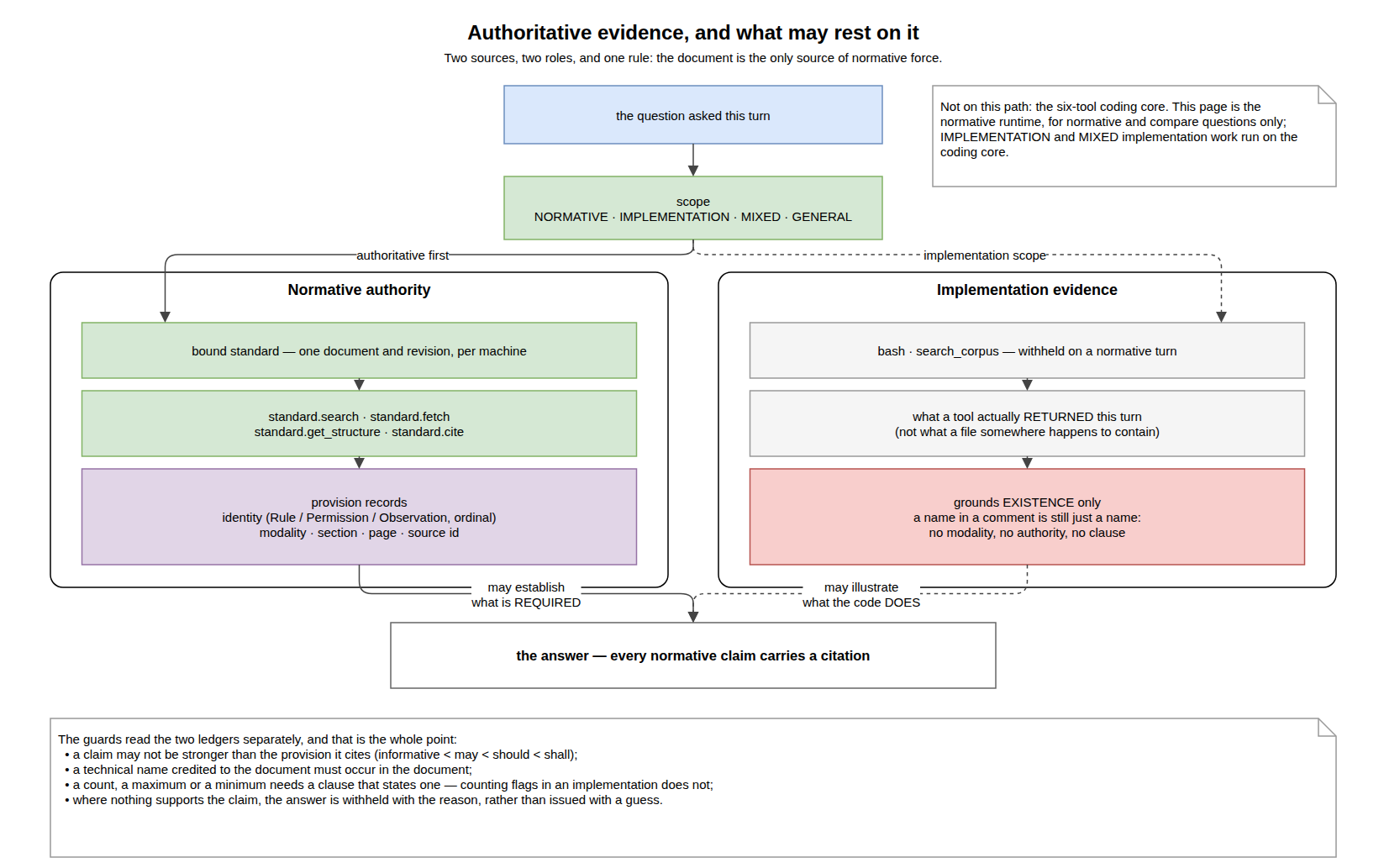
Fig. 4.1 Two sources, two roles. Only the document establishes what is required.
The rule
Authoritative source = normative authority. Implementation = implementation evidence. A claim about what is required may rest only on the first. The second may illustrate, compare and contradict — it may never establish.
4.2.1. Which documents are supported
There is no list of supported standards, and that is deliberate. Extraction is generic: any specification-style PDF can be ingested, and what SPEAR derives from it — provisions, their kinds, their ordinals, their sections and pages — is read from the document’s own structure.
What is document-specific is smaller, and it is the only thing that ever needs declaring: what this document’s provision roles mean.
Most specifications follow the conventional reading, which is the default:
Role |
May establish at most |
|---|---|
Rule, Requirement |
a requirement |
Recommendation |
a recommendation |
Permission |
a permission |
Observation, Definition, Informative |
nothing — they explain, they do not oblige |
unlabelled normative prose, and tables |
a requirement |
A profile is written only where a document’s own front matter says
something different, or where it is worth recording that the conventional
reading was checked against the document rather than assumed. Profiles live in
standard_profiles.py, one short declaration each.
Note
The last row is not a detail. A document’s bit-assignment tables usually are the requirement a Rule points at, so capping them would discard the thing the Rule refers to.
The row above it is the one profiles get written for. A document whose Observations describe an obligation in the words of that obligation will, without a profile, have those Observations read as binding — and an answer then reports the Observation as the requirement instead of the Rule that imposes it.
So: to find out whether a document works, ingest it and look at what came out.
The manifest records what was extracted and what failed, and /standard
verify checks the store against it.
4.2.2. Ingesting a document
/standard ingest <pdf> --id <id> --revision <revision>
[--retain-pdf]
[--origin LICENSED_STANDARD|PUBLIC]
[--allow-offload]
The input is a PDF. --id and --revision are how the document is named
afterwards, and they are what /standard use takes.
Flag |
Meaning |
|---|---|
|
what this document is. Defaults to |
|
keep the original file beside the extracted corpus. Without it the store holds the extraction only. |
|
embed this licensed corpus on the configured GPU host anyway, for this one command. |
--origin is not bookkeeping. A licensed corpus is not sent to a shared
embedding host: that is refused, and --allow-offload is the operator
saying otherwise once. It is a flag rather than a stored property on purpose —
relabelling the corpus PUBLIC would buy the same offload and tell
training governance the text is exportable, which is a much larger claim. It
is also what decides whether the document may travel in a container image
(Two profiles).
4.2.2.1. What ingestion produces
<store>/<id>/<revision>/
manifest.json what was extracted, and what failed
corpus/ the canonical units
source/ the original PDF, with --retain-pdf
indexes/lexical/ always built
indexes/vector/ when an embedding model is configured: the
vectors as a float32 matrix (vectors.npy)
indexes/embedding-cache/
the vectors of the last rebuild, one matrix per
embedding configuration: what a rebuild reuses
instead of embedding again
verified.json what was last checked in full, and against which files
indexes/crossrefs/ references between provisions
retrieval.json how this document is searched, once set
A document is checked in full once — every unit rehashed, every index’s
fingerprint recomputed — and the stamp of the files it was checked against
(size, mtime, ctime, inode) is recorded in verified.json. Until one of
them changes, binding and searching trust that check instead of repeating it:
for a document of 300 000 units the difference is five minutes against under
a second. Any write moves a stamp, so a changed file is always checked again;
/standard
verify
checks everything regardless.
The vector index is optional: with no embedding model configured, retrieval falls back to lexical and says so rather than failing. Where one is configured, its revision must be pinned — an unpinned model makes the index fingerprint depend on whatever the cache happened to hold.
A corpus is never embedded on the local CPU. A PUBLIC document is embedded
on the host SPEAR_STANDARD_EMBED_REMOTE names; a licensed one only with
--allow-offload. Otherwise the vector index is skipped, as if no model were
configured, unless SPEAR_STANDARD_EMBED_DEVICE names a local accelerator.
4.2.2.2. How a document is searched
Retrieval mode (lexical, vector or hybrid) and structural
completion (how many companion units a search may add) are recorded per
document, not per machine: what is measured is one document, and binding
another must not inherit its settings.
/standard retrieval                              the bound document's settings
/standard retrieval lexical --completion 2       set them
/standard retrieval <id> <revision> hybrid       for a document not bound
A document that declares nothing gets hybrid with completion 0.
SPEAR_STANDARD_RETRIEVAL_MODE and SPEAR_STANDARD_EVIDENCE_COMPLETION
still override the document for one session; /standard status and the
startup banner say when they do.
The manifest is the report:
page_count               121
canonical_unit_count    1109
requirement_count         42
recommendation_count      54
definition_count           2
extraction_errors         []
human_validation_status  NOT_REVIEWED
extractor_version        poppler-structure-v2
extraction_errors and the counts are how you judge whether a document came
out usable. A specification of 121 pages yielding four provisions did not
extract; one yielding eleven hundred units with an empty error list did.
Clause numbers are read in one of two schemes, decided once per document:
digits only (7.1.5), or with a part letter (A2.2.5, D24.2.67) as
the Arm architecture manuals number them. In a lettered document only lettered
numbers of at least two levels open a section — A64 and T32 are names
— and the running header each page repeats (A2.2 Armv8-A …, set with one
space where the heading has several) is page furniture, not a heading. A
digits-only document is extracted exactly as before; the scheme only widens
what a lettered one can be read as.
human_validation_status starts at NOT_REVIEWED and stays there until
somebody says otherwise — extraction is not review, and the field does not
pretend it is.
4.2.2.3. Seeing what is in the store
/standard list reports every ingested document with its parameters, and
marks the one currently bound:
Available standards:

  ACME-1234.5 2019-R2023  <- bound
    origin      LICENSED_STANDARD  ·  the document itself is retained
    extractor   hybrid-span-canonical-v1
    corpus      13878 units  ·  899 requirements  ·  95 recommendations  ·  355 pages
    validation  NOT_REVIEWED

  NIST-RS274NGC NISTIR6556
    origin      PUBLIC  ·  extraction only
    extractor   poppler-structure-v2
    corpus      1109 units  ·  42 requirements  ·  54 recommendations  ·  121 pages
    validation  NOT_REVIEWED
That is the answer to what do I have, and what is each one. origin says
whether a document may be embedded on a shared host and whether it may travel
in an image; the document itself is retained says the original PDF is in
the store beside the extraction; the corpus counts say whether the extraction
worked.
/standard status reports the same and much more — index states, cross
references, retrieval fingerprints, candidates — but only for the bound
document. The binding is shared by every session on the machine, so reading
list is how you look at an unbound one without changing what everyone else
is answering from.
4.2.2.4. A public standard
--origin PUBLIC is the whole difference, and it buys two things:
the corpus may be embedded on a configured GPU host without
--allow-offload, because there is nothing to keep off it;the document may travel in a
--profile publiccontainer image (Two profiles).
Nothing else changes. The extraction, the provisions, the guards and the citations are identical — a public document is not a lesser one, it is one without a restriction.
/standard ingest ~/NISTIR6556.pdf --id NIST-RS274NGC --revision NISTIR6556 --origin PUBLIC
4.2.2.5. A document with no role labels
Most documents do not label their provisions the way a VITA-style standard does, and they do not need to. Where there are no labels, the kind is read from the modal verb: must makes a requirement, should a recommendation, may a permission, and prose with no modal verb stays informative.
Ingesting NISTIR 6556, which carries no taxonomy of its own, gives:
1109 units    42 REQUIREMENT    54 RECOMMENDATION    55 MAY
              588 UNKNOWN      227 PAGE_FURNITURE   150 FRONT_MATTER
That is a working corpus. UNKNOWN is not a failure — it is prose that
obliges nobody, which in a specification is most of it.
4.2.2.6. Datasheets and other non-prose documents
A datasheet ingests, and the result has a different shape, because a datasheet states facts rather than obligations. Expect few requirement units and a great many tables. Three things follow.
The force machinery simply does not fire. There are no modalities to strengthen or contradict, so the guards that compare a claim against the force of its provision have nothing to say. They do not misfire; they stand down.
Tables carry requirement force, through the unlabelled ceiling. For a
datasheet that is usually the right reading: an absolute-maximum rating or a
register’s reset value binds as firmly as any shall.
The register maps need approving before they can be cited. A table becomes
a candidate structure at ingestion, and standard.get_structure serves
only structures a person has approved:
standard_structure_review.py --standard <id> --revision <revision> --bitfields
/standard approve-bitfield <id> <revision> <candidate-id> <verdict> <role,role,...>
/standard build-structure <id> <revision>
The structure review is operator-only: it shows each candidate as a grid with
its warnings and its sources, and prints the approve-bitfield command that
records a person’s verdict on it. build-structure promotes the approved candidates and only those. An
unapproved one has no route to an answer however it is asked for — which is
the point: a bit layout SPEAR guessed at is exactly the kind of thing that
looks authoritative and is not.
Important
A PDF has no other way in. .pdf is not among the extensions a corpus
indexes, so spear-index will not read one. If all you want is retrieval
over a document — no citations, no force, no approval step — convert it to
text or Markdown first and register that as a corpus. That is what the
posix-api corpus is: man pages as .txt.
Use the normative store when you want claims about the document to be citable and checked. Use a corpus when you want to find things in it.
4.2.2.7. The rest of the operator commands
Command |
What it does |
|---|---|
|
every ingested document with the parameters it was ingested with |
|
what is bound right now |
|
bind one |
|
bind nothing |
|
check the corpus and every index in full, then the contents table |
|
rebuild the indexes without re-extracting |
|
show or set how a document is searched |
|
alternative extractions held beside the promoted one |
|
make a candidate the corpus that answers |
|
record human validation |
|
approve one candidate structure, with the role of each field |
|
the recorded approval decisions, and whether they agree with the active approvals |
|
build the structure registry |
4.2.4. The normative tools
Tool |
What it does |
|---|---|
|
Searches the bound document with local hybrid retrieval. Every result
carries a |
|
Reads one unit by its |
|
Reads a declared structure (a layout, a table of fields) as a structure, rather than as prose that happens to contain numbers. |
|
Produces the citation for a unit already retrieved. |
The handles are deliberately not guessable and not durable across turns: a
turn may dereference only evidence it retrieved itself. A source_id seen in
an earlier turn’s transcript cannot be fetched to answer a new question from an
old question’s clauses.
4.2.5. Provision identity
A section is not a provision. One retrieved unit routinely carries a Rule, a Permission and an Observation that share an ordinal, and a claim grounded by one of them is not grounded by the others.
SPEAR therefore records provisions, not section numbers: each carries its kind (Rule, Permission, Observation, …), its ordinal, its section, its page and its source id. Two provisions that print the same label are two records, and an answer that cites the label without saying which one it means is ambiguous — which the guards report rather than resolve by guessing.
4.2.6. Normative force
Provisions are not equal. SPEAR orders what a claim may assert against what its evidence supports:
informative  <  permission  <  recommendation  <  requirement
                (may)          (should)          (shall)
A conclusion may sit at or below the level of the provision it cites, never above it. “The field shall be present” resting on a provision that says should is a strengthened modality, and is reported as one. This also catches the case with no modal verb in it at all: a bare “Yes” to “is this required?” asserts the obligation just as plainly.
The force a provision may carry is capped by its printed role. An Observation that describes an obligation is not the obligation.
4.2.8. When SPEAR withholds an answer
Where the retrieved evidence does not support the draft, SPEAR does not publish the draft with a caveat. It withholds it and says which check failed:
The retrieved normative evidence does not support this answer as written,
so it is withheld rather than shown.
  - Rule 9.9.9-1 names more than one provision (…); which one is meant
    decides the answer.
Clauses read this turn: §4.2.1, §4.3, §9.9.
That is a result, not an error. The correct next step is usually to ask a narrower question, or to name which provision is meant. See Evidence and guards for the full list of conditions and what each one asks of you.
4.2.9. An example, end to end
The document below is invented; no licensed text appears in this documentation.
> /standard status
  bound: ACME-1234.5 2019-R2023

> Explain how the frame descriptor words work and how they should be parsed
  ⎿  bound standard: ACME-1234.5 2019-R2023 — normative claims are
     grounded in it and cited
  ↪ reading the bound standard before answering — standard.search

Descriptor words are enabled by the first word of the set (§7.1, p.44).
Setting bit *n* of that word designates that word *n* is present
(Rule 7.1-3, p.44). Fields are read in descending bit order within a word
and in ascending word order (Rule 7.4.1-2, p.61).
Three things are true of that turn and are worth naming:
the first tool call was against the document, not against the source tree;
no code-reading tool was offered, because the question asked about the document and nothing else;
every sentence carries the provision it rests on, so a reader can check it without trusting the agent.
4.2.10. Questions and changes about both sides
“Compare our parser with what the standard requires” asks about both, and gets both: the normative tools and the code-reading tools are on the table together, and the answer is expected to keep the halves visibly distinct — this is what the document requires, this is what the implementation does, and here is where they differ. Nothing merges them for you; the distinction is the product.
A request to change the code so that it satisfies the standard is a different thing, and runs differently: it is a MIXED request, with its own pipeline and its own verdict. See Mixed mode.
See also