4.6. The bound-session change workflow
Most changes run on the coding core (Implementation mode), and a change that has to satisfy the bound standard runs as a MIXED request (Mixed mode). One case remains: a change asked for in a session where a standard is engaged, in words that do not make it MIXED. It runs on the normative runtime, which holds every write to a five-stage workflow. Each stage opens on a condition the runtime can check, and a stage that cannot open says so rather than proceeding on an assumption. External capabilities are not available on this path; the turn says so when its workspace has any.
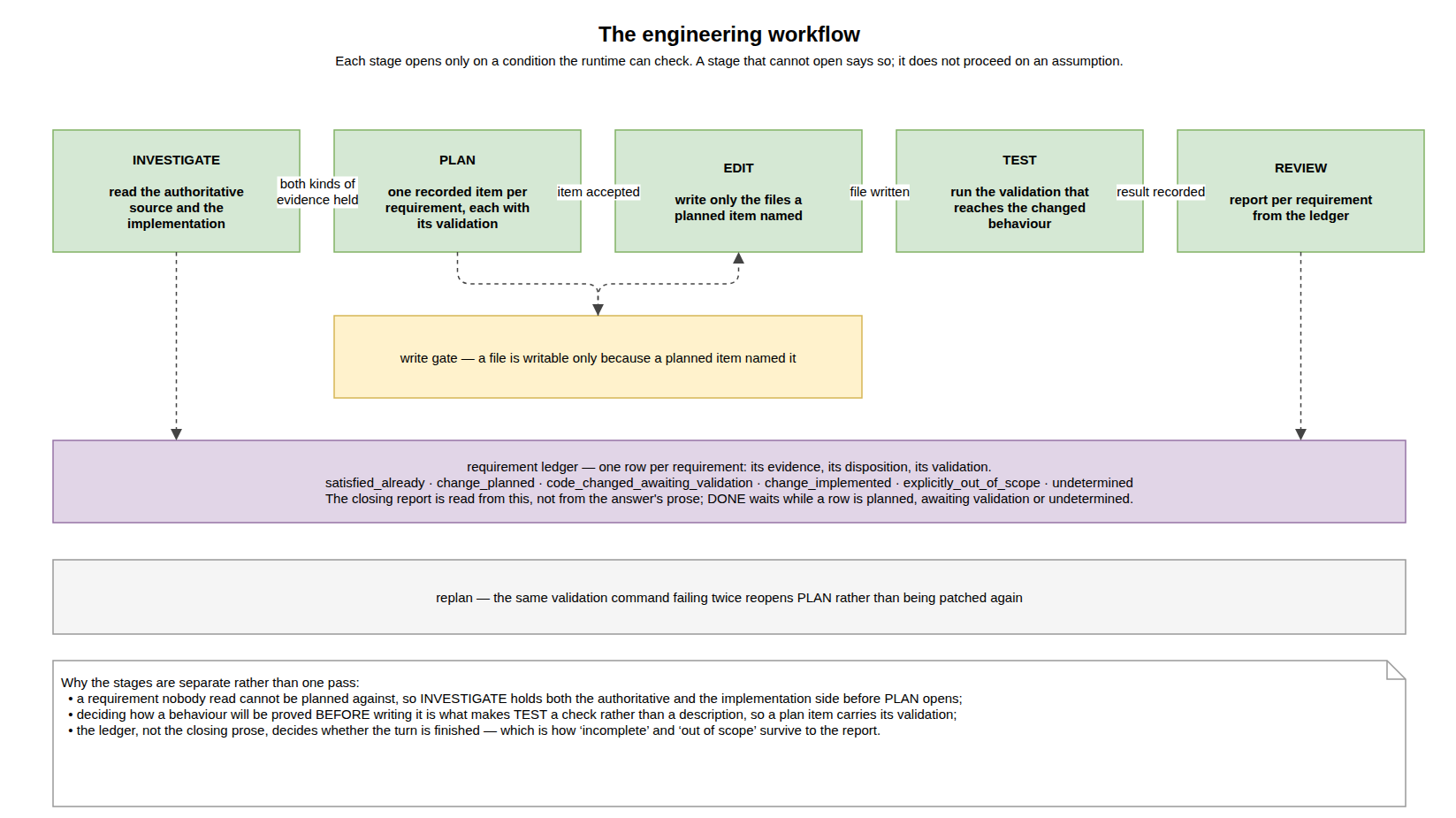
Fig. 4.3 The five stages, and the condition that opens each gate.
4.6.1. Why the stages are separate
Each separation answers a way the single-pass version fails.
INVESTIGATE before PLAN. A requirement nobody read cannot be planned against. The turn must hold both sides — what the authoritative source requires and what the implementation currently does — before a plan is accepted. Reading only one side produces a plan that is either unmoored from the specification or unmoored from the code.
PLAN before EDIT. A change described only as it is being made is a change nobody can review. Each plan item is recorded separately and names the file it will touch, which is also what opens the write gate for that file.
Validation designed before the code. A plan item carries the validation that will prove it. Deciding this after writing the code produces a test that describes what was written instead of checking what was required; deciding it first makes the test a check.
TEST reaches the changed behaviour. Running an existing suite that never enters the changed path proves nothing about it. A green run of two hundred tests is a true statement and an irrelevant one.
REVIEW reads the ledger. The closing report is generated from the requirement ledger, not from the model’s own summary of its work.
4.6.2. INVESTIGATE
The turn reads — the bound document as well as the tree — until it holds both sides of each requirement: what is required, and what the implementation does today. A write puts everything back in play, because after an edit the file is no longer the file that was read.
4.6.3. PLAN
Each requirement becomes one recorded item:
Field |
What it holds |
|---|---|
requirement |
what is required, in the document’s terms |
requirement evidence |
the provision it comes from |
current behaviour |
what the implementation does today |
implementation evidence |
the file that shows it |
gap |
the difference between the two |
correction |
the change, naming the file it lands in |
validation |
how the corrected behaviour will be proved |
An item whose validation is “the existing project test suite” is refused at this point, not at the end. So is an item with a requirement and no evidence for it.
Saying plainly that no automated test can reach a behaviour — because it needs real hardware, for example — is accepted. Silence is not.
4.6.4. EDIT
The write gate is scoped to the plan. A file becomes writable because a planned item named it, and only that file. This is deliberately per-item rather than per-contract: waiting for a whole contract to be planned before anything may be written was correct and unusable.
An edit outside the tree the session opened is refused whatever the plan says.
4.6.5. TEST
The validation designed in PLAN is run. A requirement whose code changed and whose validation has not run is not “done” — it is recorded as code changed, awaiting validation, and the closing report says so.
A validation that fails the same way twice does not get patched a third time. It reopens PLAN, because two identical failures against the same design are evidence about the design.
4.6.6. REVIEW
The requirement ledger is published as a matrix: one row per requirement, with its evidence, its disposition and whether its validation ran.
Three dispositions matter more than the rest, because they are the ones a summary tends to lose:
Disposition |
Meaning |
|---|---|
|
the implementation already met it; no change was needed |
|
deliberately not addressed, with the reason recorded |
|
could not be established from what the turn read |
A requirement that was reviewed and excluded is named in the report together with why. Narrowing the work is a visible decision, not a silence.
Note
If the closing prose claims the work is complete while the ledger still has an open row, the report says to take the matrix and not the claim. The ledger has the last word, and “incomplete” is a correct result when it is the true one.