7.3. Testing
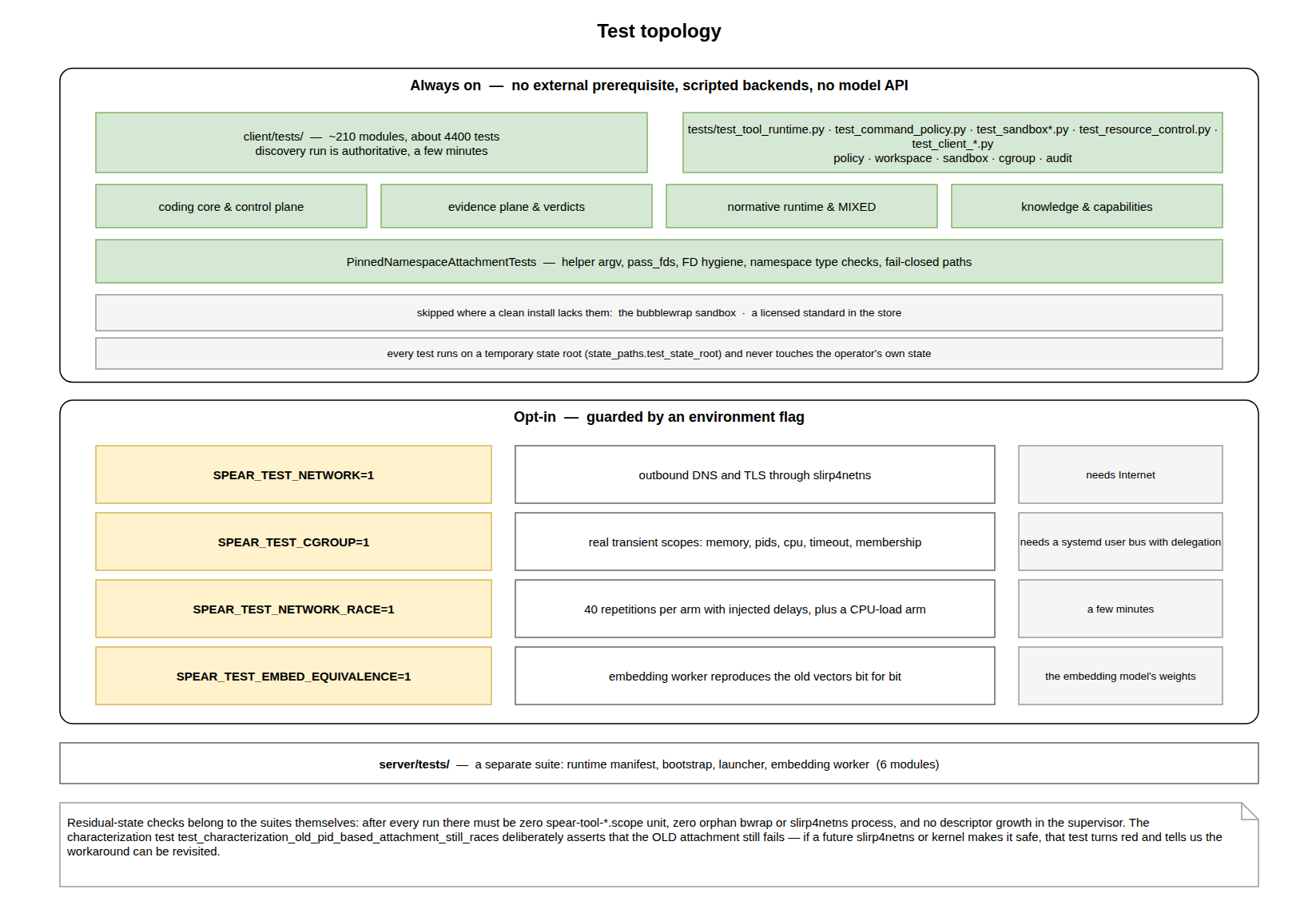
Fig. 7.1 Always-on suites, opt-in suites, and what each one needs.
7.3.1. Running the suites
Everything uses the application’s own virtualenv:
$ cd ~/spear/client

$ ./bin/python -m compileall -q agent cli context evidence harness models normative retrieval runtime standard training
$ PYTHONPATH=. ./bin/python -m unittest discover -s tests -p "test_*.py"
Ran … tests — OK (skipped=…)
The discovery command is authoritative: about 4400 tests, a few minutes. It covers the coding core and its control plane, the evidence plane and its verdicts, the normative runtime and the MIXED orchestration, workspace context, knowledge and capabilities, sessions, verification, checkpoints, the tool architecture and the security substrate — with scripted backends; it does not require a real model API.
A test never touches the operator’s own state. One that names no state
directory is given a temporary one (state_paths.test_state_root), removed
when the run exits, and the knowledge store refuses to open its default path
under test at all.
Most skips are the opt-in suites below. The others are tests that need what a clean install does not have: the bubblewrap sandbox, or a licensed standard in the store. A checkout with no Internet, no systemd user bus and no patience still runs the full always-on set.
The server component has its own suite — the runtime manifest, the bootstrap, the launcher and the embedding worker — run from the same directory:
$ ./bin/python -m unittest discover -s ../server/tests -p "test_*.py"
7.3.2. Opt-in suites
Flag |
What it exercises |
Requires |
|---|---|---|
|
outbound DNS and TLS through slirp4netns |
Internet access |
|
real transient scopes: memory, pids, cpu, timeout cleanup, membership |
a systemd user bus with cpu/memory/pids delegation |
|
40 repetitions per arm with injected delays, plus a CPU-load arm |
a few minutes |
|
the server’s embedding worker reproduces, bit for bit, the vectors of the worker it replaced |
the embedding model’s weights ( |
$ SPEAR_TEST_NETWORK=1     ./bin/python -m unittest tests.test_sandbox_network.Slirp4netnsNetworkTests
Ran 29 tests — OK
$ SPEAR_TEST_CGROUP=1      ./bin/python -m unittest tests.test_resource_control.OptInRealCgroupTests
Ran 6 tests — OK
$ SPEAR_TEST_NETWORK_RACE=1 ./bin/python -m unittest tests.test_sandbox_network.OptInNetworkRaceTests
Ran 4 tests — OK
7.3.3. What the suites assert
7.3.3.1. Negative properties
Much of the value is in asserting that things do not happen. These are easy to satisfy by accident with a test that only checks a return status, so they are checked at the mechanism level instead:
popen.assert_not_called()— a fail-closed decision spawned nothing;self.assertEqual(writes, [])— no release write followed a setup failure, i.e. the sandboxed command never started;the marker file the command would have created does not exist;
the supervisor’s descriptor count did not grow;
no residual
spear-tool-*unit, no orphanbwraporslirp4netns.
7.3.3.2. Descriptor and namespace hygiene
PinnedNamespaceAttachmentTests is always on and fast (~0.2 s). It checks
the helper argv and its exact pass_fds, that the command’s descriptor table
contains no namespace handle, that the supervisor leaks nothing on success, on
setup failure or on a Python exception, and that both fail-closed paths — an
incapable helper, and an inode mismatch — refuse without releasing.
7.3.3.3. The characterization test
test_characterization_old_pid_based_attachment_still_races deliberately
asserts that the old PID-based attachment still fails (10 out of 10 with
a 20 ms delay).
That looks backwards until you consider what it protects. The pinned attachment exists to work around a real interaction between bwrap’s two-step user namespace and slirp4netns. If a future kernel or helper made the simple form safe, this test turns red — and tells us the workaround can be revisited — instead of leaving a permanent unexplained complication in the code.
7.3.4. Determinism
The always-on suites are deterministic. One property required care:
Do not instrument the critical window
Any synchronous work between reading bwrap’s info-fd and spawning the
network helper breaks the network path (Network backend). A test that wants
to observe the live scope must sample from a side thread, and that
thread must be cheap — an early version scanned all of /proc every
10 ms and made the suite flaky through GIL contention alone.
OptInRealCgroupTests samples via /proc/self/task/*/children rather
than a full /proc walk, and stops the watcher between attempts.
A second, pre-existing property is worth knowing: under heavy artificial CPU
load the network suites can still hit slirp4netns failed to become ready,
because the readiness wait is a wall-clock timeout. That is a property of the
timeout, not of the attachment.
7.3.5. Residual state
After a full run, all four must hold:
$ systemctl --user list-units --all 'spear-tool-*' --no-legend | wc -l
0
$ pgrep -a bwrap ; pgrep -a slirp4netns
(nothing)
$ ls /sys/fs/cgroup/user.slice/user-*.slice/user@*.service/app.slice/spear-tool-* 2>/dev/null
(nothing)
and the supervisor’s descriptor count is unchanged across repeated runs.
Note
Orphan bwrap processes observed during development came from ad-hoc
diagnostic scripts that killed bwrap without going through the pidfd
sequence — not from the runtime. They are recognisable by their workspace
path: the runtime always uses a /tmp/spear-slirp- prefix.
7.3.6. Live smoke test
The end-to-end check that serving and the backend contract are both healthy is
in Model serving; the expected answer is end_turn /
SPEAR-BACKEND-OK / empty tool tuple.