5.6. Final harness audit
This page records the final evidence-driven production profile. It is a description of the current implementation, not a promise of model quality.
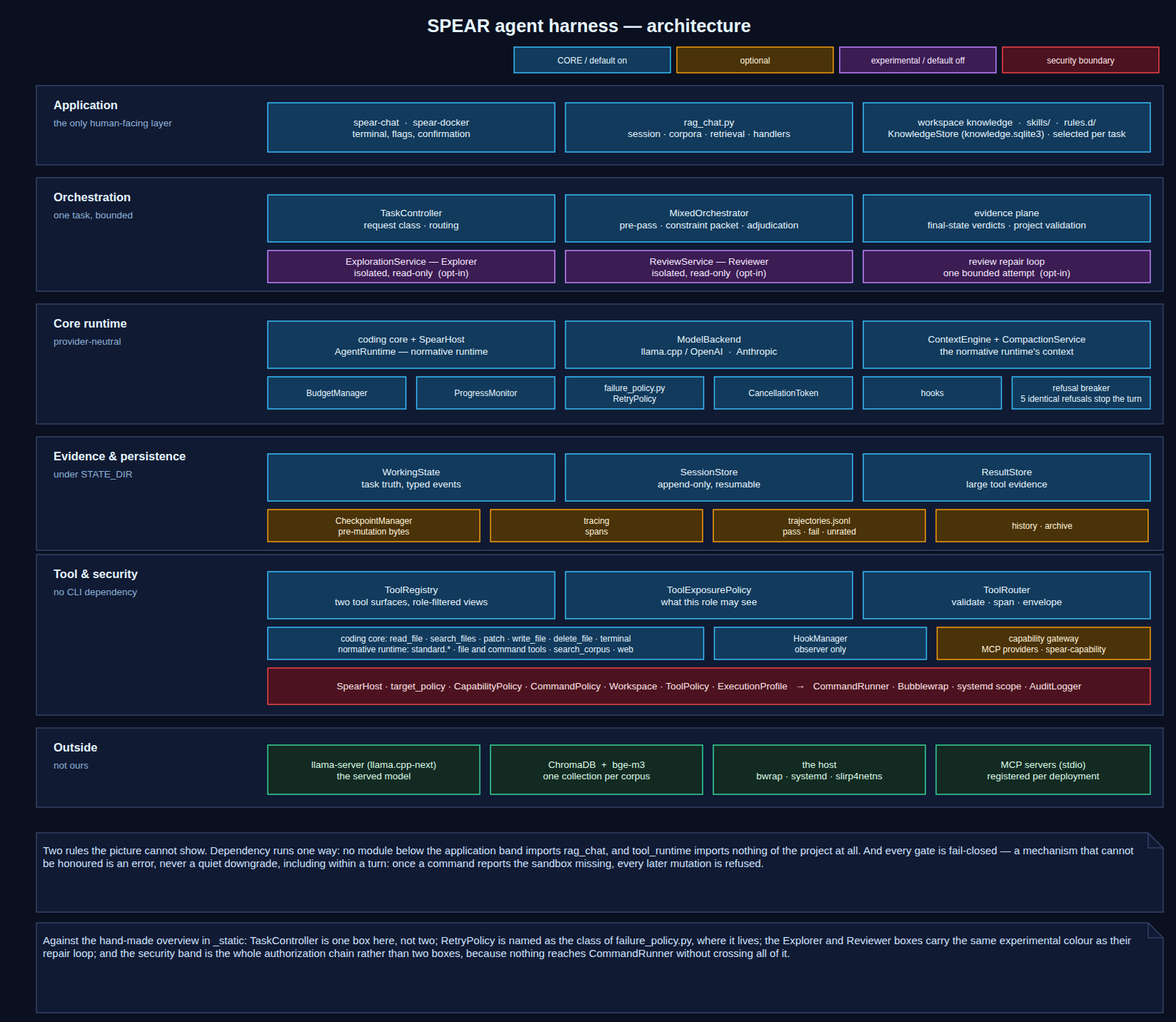
Fig. 5.6 The whole harness on one sheet — the layers, what is on by default, what is optional, what is experimental, and where the security boundary runs. Architecture shows how the request classes route through it.
Every box in the picture can be checked against the tree. It replaced a hand-drawn
version of the same figure that had TaskController in two bands and drew
RetryPolicy beside FailurePolicy although the second contains the first
(failure_policy.py). That drawing is kept as the
Final_architecture page of source/img/spear.drawio and in _static/,
because it is a fine overview.
5.6.1. Production maturity
CORE / DEFAULT ON
request classification and routing (
TaskController,answer_scope)the coding core and
SpearHost, its control planethe evidence plane: canonical evidence, source epochs, the implementation verdict and project validation
the MIXED orchestration: constraint packet, structural coverage, applicability, source predicates and bound conformance checks
AgentRuntime(the normative and general runtime)WorkingStateandContextEnginetransactional semantic compaction
selected
MarkdownMemoryStorememories and workspace knowledge (KnowledgeStore)ToolRegistry/ToolRouter/ResultStoreSessionStoreand cancellationVerificationPolicyandCheckpointManagerBudgetManager,FailurePolicyandProgressMonitorrole-aware tool exposure and tracing
OPTIONAL
deterministic planning when
PlanningPolicyidentifies a complex taskexternal capabilities, when a deployment registers MCP providers (
capability_gateway.py)compatibility code-block mutation fallback
legacy
chat_onceandexecute_toolAPIs
EXPERIMENTAL / DEFAULT OFF
Explorer
Reviewer
reviewer-driven repair
OPERATOR-ONLY, OUTSIDE THE TURN
the training subsystem — capture, curation, governance, readiness, frozen bundles, and the launcher. Nothing in it is model-visible and freezing runs no training; its own readiness vocabulary tops out at
READY_FOR_EXPERIMENT(Training and fine-tuning).
Explorer and Reviewer remain isolated, read-only roles and can be enabled by
an explicit TaskRequest or benchmark configuration. They are not
constructed, budgeted or given child sessions on the normal default path.
With the measured Qwen3-Coder-Next configuration, targeted child runs
started but exhausted their eight-turn contract without a valid structured
deliverable; no quality benefit is claimed.
5.6.2. Evidence
The initial real-model benchmark achieved 15/18 deterministic fixture tasks (83.3 percent). Selected memory achieved 4/4 both with and without injection, with lower context/call cost when selected. Role-aware views expose two or five tools instead of seven in the tested roles. Targeted context fixtures caused compaction to reduce an approximately 65K-token estimate to roughly 10K in completed runs. These are finite Qwen3-Coder-Next measurements, not statistical or universal claims.
5.6.3. Ownership invariants
WorkingState is task truth; SessionStore is resumable runtime state;
CheckpointManager is filesystem recovery; ResultStore owns large tool
evidence; MarkdownMemoryStore owns durable memories and KnowledgeStore
the workspace’s knowledge; ContextEngine is the
only production context composer; and BudgetManager owns agent-level
budgets. Legacy projections remain only where CLI/history compatibility or
weaker local models require them.
5.6.4. Security and provider boundary
All command execution still passes ToolRouter’s authorization and the
CommandPolicy/CommandRunner/Bubblewrap boundary — the coding core’s included,
through SpearHost. The two host commands, spear-capability and
spear-knowledge, are answered by SpearHost and never reach a shell; the MCP
providers behind the first run on the host, outside the sandbox, under the
gateway’s read/write policy. Read-only child roles receive
no checkpoint, memory-write, web or mutating-tool capability. Lower runtime
modules do not import the CLI, and provider-specific protocol details remain
inside backend adapters.
5.6.5. Known limitations and future candidates
The code-block fallback, chat_once/enforce_ctx_budget compatibility
path and string execute_tool facade remain maintenance debt because tests
and legacy callers still reach them.
ToolSpec.execution_modes is enforced by ToolRouter: a tool called in a
mode its spec does not declare is denied (execution_mode_denied), and a
mutating spec must declare its modes and may not declare safe. It does not
filter what the registry exposes, and it adds to, rather than replaces, the
authorization in CapabilityPolicy and CommandPolicy
(Security model). Explorer/Reviewer contract reliability,
long-context benchmark scoring and repair quality need more model evidence.
ToolSearch, parallel agents, model routing, new retrieval, and new planning or
review capabilities are deliberately not implemented.