5.3. Sandbox
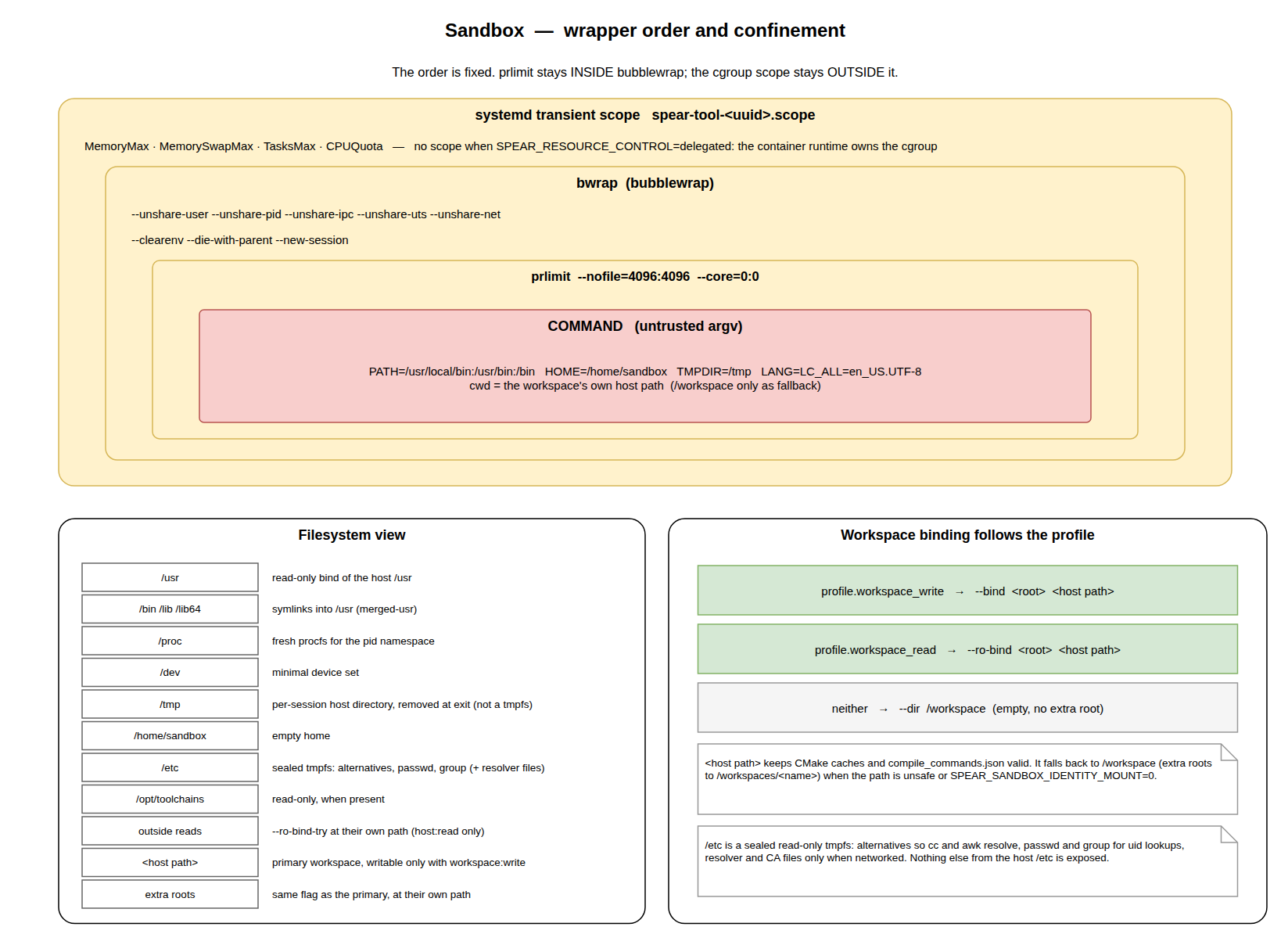
Fig. 5.3 The wrapper order is fixed: the cgroup scope outside, prlimit inside.
5.3.1. Wrapper order
systemd-run --scope        (cgroup limits: the whole tree)
  └── bwrap                (namespaces, mounts, environment)
        └── prlimit        (per-process rlimits)
              └── COMMAND  (untrusted argv)
This order is a contract, not an accident, and three inversions are explicitly forbidden:
prlimit → systemd-runwould apply the descriptor limit to systemd’s client rather than to the workload.
bwrap → systemd-runwould put the scope inside the sandbox, where the sandboxed process could observe and interfere with it.
systemd-run → prlimit → bwrapwould apply rlimits to
bwrapitself, not to the command, and would break bwrap’s own setup.
The reason prlimit must stay inside is simple: rlimits are per-process and
inherited across fork. Applied inside, they land on the command and every
child it spawns. Applied outside, they land on bwrap, which is not the
process anyone is trying to constrain.
5.3.2. Namespaces
--unshare-user  --unshare-pid  --unshare-ipc  --unshare-uts  --unshare-net
--clearenv  --die-with-parent  --new-session
--unshare-net is unconditional — including for the network profile. The
sandbox always starts with no network at all; connectivity, when granted, is
added afterwards by attaching a helper to the private namespace
(Network backend). There is no code path in which the command shares the host
network namespace.
--die-with-parentAnchors the sandbox lifetime to the Python supervisor via
PR_SET_PDEATHSIG. This still holds under the systemd scope:systemd-run --scopeexecs in place, sobwrap’s parent remains the supervisor.--new-sessionDetaches from the controlling terminal, so a sandboxed process cannot inject input into the user’s terminal with
TIOCSTI.--clearenvThe environment boundary. It is what allows the supervisor to pass
XDG_RUNTIME_DIRtosystemd-runwithout any risk of that variable reaching the command.
5.3.3. Filesystem
Mount |
Nature |
|---|---|
|
read-only bind of the host |
|
symlinks into |
|
fresh procfs for the private PID namespace |
|
minimal device set |
|
a private per-session directory, outside the workspace, removed when
the session ends ( |
|
empty directories |
|
private tmpfs, sealed read-only, containing only |
|
read-only, when the host has it — cross-toolchains linked from
|
outside reads |
only when |
the workspace |
the only host-writable mount, at its own host path by default (see
below); the registered corpora beside it unless |
Environment:
PATH=/usr/local/bin:/usr/bin:/bin   LANG=LC_ALL=en_US.UTF-8
HOME=/home/sandbox   TMPDIR=/tmp    cwd=<the workspace mount>
5.3.3.1. Workspace binding follows the profile
profile.workspace_write  →  --bind     <host workspace>  <mount>
profile.workspace_read   →  --ro-bind  <host workspace>  <mount>
neither                  →  --dir      /workspace
A read-only profile therefore cannot write even by accident: the restriction is a mount option, not a check in Python.
<mount> is the workspace’s own host path, so a build tree configured
outside the sandbox keeps working inside it — CMake caches, generated
Makefiles and compile_commands.json all embed absolute paths.
/workspace is used instead when the host path would be unsafe to mirror,
or when SPEAR_SANDBOX_IDENTITY_MOUNT=0.
5.3.3.2. /etc and the alternatives system
The host /etc is never exposed. The sandbox gets its own tmpfs, into
which one host directory and two world-readable identity files are bound
read-only:
--tmpfs /etc
--ro-bind /etc/alternatives /etc/alternatives
--ro-bind /etc/passwd /etc/passwd   --ro-bind /etc/group /etc/group
…                                              (resolver files, if network)
--remount-ro /etc
passwd and group are there because build tools resolve uids and gids
through them — BitBake refuses to start without them.
/etc/alternatives is there because cc, awk, editor and a
number of other commands are symlinks through it. Without it they dangle, and
a plain make fails with cc: No such file or directory while gcc
works — a confusing way to lose the C toolchain. The directory holds no data
of its own: every entry is a symlink into /usr, which is already visible
read-only.
The --remount-ro is what keeps the strong property intact. A --dir or
a plain tmpfs would be writable, so a command could create files under
/etc inside its sandbox. Nothing would reach the host, but “nothing
outside the workspace is writable” would no longer be literally true. A
tmpfs is a real mount point and can therefore be sealed once every bind is in
place — which is why the seal is emitted last, after the network profile’s
resolver files.
Verified from inside:
$ ls -A /etc
alternatives  group  passwd
$ cc --version | head -1
cc (Ubuntu 13.3.0-6ubuntu2~24.04.1) 13.3.0
$ touch /etc/x
touch: cannot touch '/etc/x': Read-only file system
5.3.4. Per-process limits
DEFAULT_RESOURCE_LIMITS = ResourceLimits(nofile=4096, core_bytes=0)
Only two limits are on by default, and the omissions are deliberate:
nofile=4096Bounds descriptor fan-out.
core_bytes=0No core dumps.
cpu_secondsLeft unset: a wall-clock timeout already exists, and a CPU-second limit kills legitimate long compiles.
file_size_bytesLeft unset:
RLIMIT_FSIZEis not a workspace quota — it caps individual file size, which breaks legitimate link and archive steps while doing nothing about a workload writing a million small files.
Hard and soft values are set equal, so an unprivileged child cannot raise its own soft limit back up.
5.3.5. Execution paths
5.3.5.1. Closed network
run() builds the bwrap argv, wraps it in a scope if cgroup limits are
active, spawns it with env={} (or the supervisor environment when scoped),
and waits with a bounded communicate(timeout=...). The sandbox’s own
defaults are 45 s and 10 000 characters per stream; the coding core’s
terminal replaces them for its call (180 s by default, at most 600 s, and
its own 50 000-character head/tail bound, Tool execution harness). A cancelled
turn stops the command the same way a timeout does.
On timeout it terminates the scope first — systemd reaches descendants a
Popen handle cannot — then stops the process without waiting for EOF.
Every wait on that path is bounded; a stuck tree cannot block the supervisor.
5.3.5.2. Network
_run_with_slirp() coordinates bwrap’s private network namespace with the
helper’s ready/exit protocol. It is described in full in Network backend.
5.3.6. Preflight
preflight() runs a real mini-sandbox rather than probing a version:
test "$PWD" = <mount> && test -w <mount> \
  && test "$HOME" = /home/sandbox && test "$TMPDIR" = /tmp
where <mount> is the path the workspace answers to inside the sandbox.
If that fails, availability becomes REFUSED and stays there. A version
number cannot tell you whether unprivileged user namespaces are permitted on
this kernel; running the thing can.
preflight_network() exercises the complete pidfd + slirp path with
/bin/true before the first real network use, so the first failure is
observed on a trivial command rather than in the middle of the user’s work.