5.5. Resource control
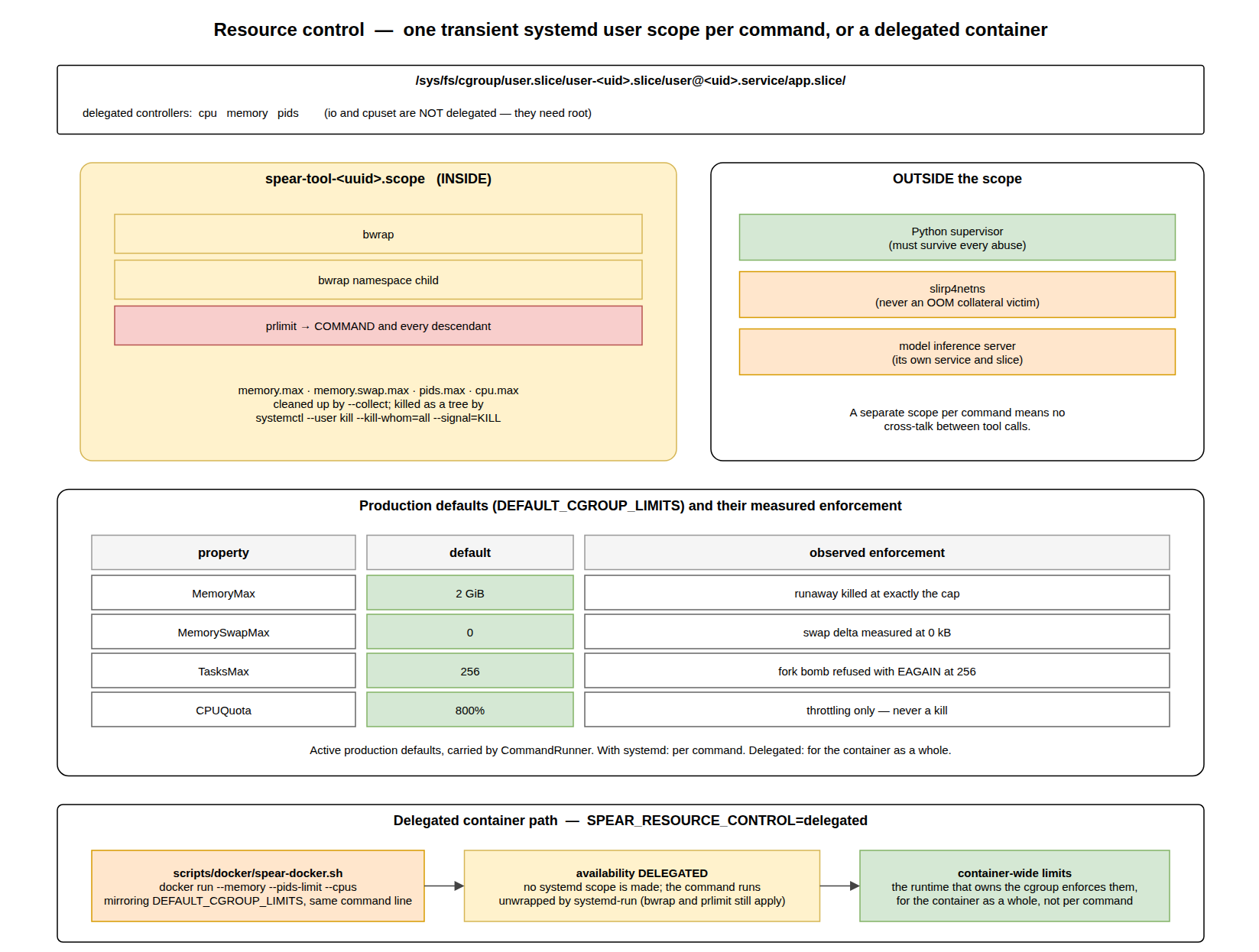
Fig. 5.5 One transient scope per command; the supervisor and the helpers stay outside it.
5.5.1. Two contracts, not one
ResourceLimits and CgroupLimits are orthogonal and neither replaces the
other.
|
|
|
|---|---|---|
Mechanism |
|
cgroup v2 via a transient systemd scope |
Granularity |
per process |
whole tree |
Bounds |
descriptors, core size |
memory, task count, CPU |
Enforcement |
the kernel, per-process rlimits |
the kernel, per-cgroup |
A per-process descriptor limit says nothing about a thousand processes each opening four thousand descriptors. A cgroup memory limit says nothing about a single process exhausting its descriptor table. Both are needed.
Deliberately not used
RLIMIT_NPROC is not a substitute for pids.max: it is per-user,
not per-tree, so it would be shared with the supervisor and with every
other process the user is running.
RLIMIT_AS is not a substitute for memory.max: it caps virtual
address space, which modern allocators and any mmap-heavy tool reserve far
in excess of what they touch.
io and cpuset are out of scope: they are not delegated to a regular
user session.
5.5.2. The contract
@dataclass(frozen=True)
class CgroupLimits:
    memory_max_bytes: int | None = None        # None or >= 1
    memory_swap_max_bytes: int | None = None   # None or >= 0
    tasks_max: int | None = None               # None or >= 1
    cpu_quota_percent: int | None = None       # None or >= 1
A bare CgroupLimits() is inactive — every field None, no wrapper, no
systemd. The production contract is the populated
DEFAULT_CGROUP_LIMITS shown below.
bool is rejected explicitly on every field: type(value) is not int
catches it, because True would otherwise silently become 1.
Swap is not implied by memory_max_bytes. Coupling the two is a policy
decision, so the mechanism keeps both knobs independent and independently
testable:
CgroupLimits(memory_max_bytes=1024).systemd_properties()
# ['MemoryMax=1024']            — no MemorySwapMax
Only the controllers the active fields need are required:
memory_* → memory, tasks_max → pids,
cpu_quota_percent → cpu. A memory-only contract does not demand the
cpu controller.
5.5.3. The transient scope
One scope per sandboxed command, named from a UUID only:
/usr/bin/systemd-run --user --scope --quiet --collect
    --unit=spear-tool-<uuid4 hex>.scope
    -p MemoryMax=…  -p MemorySwapMax=…  -p TasksMax=…  -p CPUQuota=…%
    -- bwrap … /usr/bin/prlimit … -- COMMAND
An inactive contract produces the bwrap argv unchanged — no wrapper, no
systemd-run, no behavioural difference at all.
5.5.3.1. Why --scope and not a service
systemd-run --user --scope execs in place. The measured consequence:
Popen pid   = 1527306
inner pid   = 1527306        identical
So the Popen handle still refers to bwrap; --die-with-parent still
anchors to the supervisor; inherited descriptors keep their numbers (fd 4
stays fd 4); and the exit code propagates untouched (exit 7 → rc=7).
Nothing in the existing process model had to change.
5.5.3.2. Why --collect
Without it, a failed or OOM-killed scope lingers in failed state and the
units accumulate. With it, units are released as soon as they finish.
Verified after exit 7, after an OOM kill and after a forced stop: zero
residual spear-tool-* units. No reset-failed sweep is needed.
5.5.4. Availability and the user bus
class CgroupAvailability(StrEnum):
    UNKNOWN, AVAILABLE, SYSTEMD_RUN_ABSENT, DELEGATED, SYSTEMCTL_ABSENT,
    USER_BUS_UNAVAILABLE, CONTROLLERS_UNAVAILABLE, REFUSED
Detection reads no secret: it checks that systemd-run and systemctl
exist and are executable, that $XDG_RUNTIME_DIR is a directory, that
…/bus is a socket (S_ISSOCK — the socket is never connected to or
read), and that the required controllers are delegated.
5.5.4.1. Delegation to a container runtime
Inside a container there is no systemd to make a scope with, but the cgroup
belongs to the container runtime. scripts/docker/spear-docker.sh starts
the container with --memory, --pids-limit and --cpus mirroring
DEFAULT_CGROUP_LIMITS, and sets SPEAR_RESOURCE_CONTROL=delegated on the
same command line. With that variable, availability is DELEGATED and the
command runs unwrapped: the contract is honoured by the runtime that owns the
cgroup, for the container as a whole rather than per command, not dropped. Nothing in SPEAR can verify the claim, which is why the
flags and the variable live together in one launcher.
5.5.4.2. The supervisor environment
The harness historically launched bwrap with env={}. systemd-run --user
cannot reach the user bus that way:
env={}                          → exit 1, "Failed to connect to bus: No medium found"
XDG_RUNTIME_DIR only            → exit 0
So exactly one variable is passed, and only to systemd-run:
def supervisor_env(self):
    return {"XDG_RUNTIME_DIR": str(self.runtime_dir())}
where runtime_dir() is the supervisor’s own $XDG_RUNTIME_DIR, or
/run/user/<uid> when it is unset.
Because bwrap applies --clearenv, this cannot reach the command. The
tests assert both halves: the scoped Popen receives that environment, the
unscoped one receives {}, and --clearenv is present either way.
Note
loginctl enable-linger is never invoked. Without a user bus — a
non-interactive ssh session or a cron job on a machine without lingering —
the harness fails closed. Enabling lingering is a deployment decision, not
something a tool runtime should do to the host.
5.5.5. Delegation on this machine
$ cat /sys/fs/cgroup/user.slice/user-1000.slice/user@1000.service/cgroup.controllers
cpu memory pids

$ systemctl show user@1000.service -p Delegate -p DelegateControllers
Delegate=yes
DelegateControllers=cpu memory pids
Exactly the three controllers the contract needs. io and cpuset are
not delegated, which is why they are out of scope rather than merely unused.
5.5.6. Termination
Forced termination targets the unit by its unique generated name:
subprocess.run([systemctl, "--user", "kill", "--kill-whom=all",
                "--signal=KILL", unit],
               timeout=5, shell=False)
Measured against the alternative:
|
|
|
|---|---|---|
latency |
0.007 s |
0.038 s |
bwrap return code |
-9 |
-15 |
cgroup afterwards |
gone |
gone |
unit afterwards |
collected |
collected |
sibling helper |
untouched |
untouched |
Both work; kill is faster and unambiguous, so it is what the timeout path
uses. No numeric PID tree walking is involved, and the unique unit name means
there is no reuse race.
Note
Direct writes to cgroup.kill are permitted on a systemd-managed scope
— this was tested, and it works. The harness does not use it anyway:
letting systemd own the unit lifecycle keeps --collect in play and
avoids hand-building cgroup paths.
5.5.7. Calibration
Measured on this machine (62.25 GiB RAM, 22 CPUs, 2 GiB swap), three repetitions each, under a deliberately non-constraining contract.
Workload |
wall min/med/max (s) |
memory.peak (MiB) |
pids.peak |
CPU |
|---|---|---|---|---|
read-only find + grep |
0.03 / 0.04 / 0.05 |
3.0 / 3.2 / 3.3 |
5 |
n/a |
python unittest |
0.19 / 0.20 / 0.22 |
77.5 / 77.6 / 78.2 |
3 |
n/a |
python CPU + alloc |
0.46 / 0.51 / 0.53 |
143.1 / 143.6 / 143.6 |
3 |
n/a |
make -j1 |
4.15 / 4.20 / 4.23 |
29.6 / 30.1 / 52.3 |
6 |
n/a |
make -j2 |
2.31 / 2.32 / 2.55 |
54.2 / 54.6 / 55.3 |
7 |
n/a |
make -j22 |
0.69 / 0.70 / 0.71 |
496.2 / 512.9 / 517.9 |
47 |
n/a |
shell pipeline |
0.04 / 0.05 / 0.05 |
10.2 / 10.4 / 10.4 |
9 |
n/a |
git init/add/commit/diff |
0.05 / 0.05 / 0.06 |
3.4 / 3.6 / 3.8 |
5 |
n/a |
Note
nr_periods, nr_throttled and throttled_usec only exist once
cpu.max is set. In the unlimited arms they are structurally absent,
not missing measurements — hence n/a rather than zero.
5.5.7.1. CPU quota grid
make -j22, the most parallel workload:
CPUQuota |
wall min/med/max (s) |
slowdown |
periods |
throttled |
throttled_usec |
|---|---|---|---|---|---|
unlimited |
0.75 / 0.75 / 0.76 |
1.00× |
n/a |
n/a |
n/a |
200 % |
4.77 / 4.80 / 4.99 |
6.36× |
48 |
47 |
76 323 725 |
400 % |
2.33 / 2.37 / 2.53 |
3.14× |
23 |
22 |
34 075 797 |
800 % |
1.32 / 1.34 / 1.37 |
1.77× |
13 |
11 |
12 428 460 |
make -j2 shows zero throttled periods at 400 % and 800 %, and a
single-threaded Python workload is untouched at every quota.
5.5.8. Production defaults
These are active. CommandRunner carries them, so every command
rag_chat runs is scoped (or, in a delegated container, bounded by the
container’s own limits):
DEFAULT_CGROUP_LIMITS = CgroupLimits(
    memory_max_bytes      = 2_147_483_648,   # 2 GiB — 4.1x the 518 MiB peak
    memory_swap_max_bytes = 0,               # measured swap delta: 0 kB
    tasks_max             = 256,             # 5.4x the observed peak of 47
    cpu_quota_percent     = 800,             # no throttling except a massive build
)
Ownership: the contract belongs to CommandRunner, not to the sandbox.
BubblewrapSandbox.run() called without an explicit cgroup_limits
applies none — it is a mechanism, and keeping it that way is what lets
preflight and the test suite run without a systemd user bus. The production
path is rag_chat → CommandRunner.run_sandboxed() → sandbox.run(…,
cgroup_limits=self.cgroup_limits) — for the coding core’s terminal calls
too, which reach it through SpearHost.
Observed on the live cgroup of a scoped production command:
memory.max        = 2147483648
memory.swap.max   = 0
pids.max          = 256
cpu.max           = 800000 100000
Note
The values converge a few tens of milliseconds after Popen returns:
systemd-run is exec’d immediately, the scope is created over D-Bus, and
the cgroup files exist with their default (max) values in between. Any
instrumentation that reads them once, early, will see max and conclude
the limits are not applied. Poll until they converge.
The workload itself is never in that window — systemd-run completes the
scope job before exec’ing bwrap, and the adversarial results below are
the empirical proof: the runaway is killed at exactly the cap.
Enforcement of that combined contract, measured:
Attack |
Result |
|---|---|
allocate 8 GiB |
killed at exactly the 2048 MiB cap; swap delta 0 kB; |
fork 2000 processes |
refused at |
44 concurrent CPU loops |
throttled only — |
In all three the supervisor survived, llama-server was untouched in
system.slice, and no residual scope remained.
All of the above was re-verified through the production path after activation, with no limits passed by hand.
5.5.9. Portability
Value |
Portable? |
Why |
|---|---|---|
|
yes |
depends on no host resource |
|
reasonably |
3 % of RAM here; 50 % of a 4 GiB machine — permissive in relative terms but still protective in absolute ones |
|
fragile |
the peak tracks |
|
fragile |
36 % of this machine; 100 % of an 8-core one (no real cap at all); 4 % of a 192-thread host |
Fixed defaults are recommended anyway: they are simpler, deterministic in
tests, and correct on the only deployment host today. A host-relative policy
(min(nproc, 8) * 100 %, nproc * 12 tasks, MemTotal / 32) would be
fairer across a heterogeneous fleet, at the cost of putting environment
dependence into a security path. The condition that should trigger that
change is SPEAR running on a many-core host.