5.1. Tool execution harness
Six modules of harness/ are the security and command-execution substrate:
tool_primitives.py (modes, capabilities, ToolResult),
command_policy.py, workspace.py, sandbox.py,
resource_control.py and tool_runtime.py (CommandRunner,
AuditLogger). The provider-neutral lifecycle above it is split between
ToolRegistry, ToolRouter, AgentRuntime and TaskController;
none imports rag_chat. The substrate remains independently testable.
5.1.1. Two tool surfaces
The registry serves two vocabularies, and a turn sees exactly one of them:
The coding core’s six tools — read_file, search_files, patch,
write_file, delete_file, terminal — on every request with no
standard engaged, and in the implementation pass of a MIXED request (it needs
an OpenAI-compatible endpoint). The core reaches the harness through SpearHost
(control_plane.py, Implementation mode), which calls the same
router authorization, workspace resolution, target policy, command policy and
sandbox described below. External capabilities and workspace knowledge add no
tool: they are reached with the spear-capability and spear-knowledge
host commands, which SpearHost answers itself and never hands to a shell
(The control plane in front of the coding core).
The normative runtime’s tools — the standard.* tools, the file and
command tools of that runtime, search_corpus, and the web pair — in a
session where a standard is engaged, filtered further by what the turn asks
about: a purely normative question is offered no tool that reaches a working
tree.
Neither surface sees the other’s tools, and the coding core never sees a normative one.
5.1.2. The web pair
search_internet finds pages; fetch_url reads one, or saves it with
save_as. Both run in the chat process rather than the sandboxed shell, so
reading works in SAFE; saving is a mutation and takes the ordinary write
authorization. A long PDF comes back in slices and each names the pages
range that continues it — told only that the answer was truncated, a model
re-fetches the same url.
Their exposure follows web_enabled alone. It used to depend on matching
the objective against \b(web|internet|online|latest|current release)\b,
which withheld both tools whenever the phrasing missed — “please get the
complete Code-G pdf” matched nothing, and so did a bare fetch https://….
The two schemas that gate saved measure 155 tokens of a 65536-token window; a
tool the model cannot see is one it narrates instead of using.
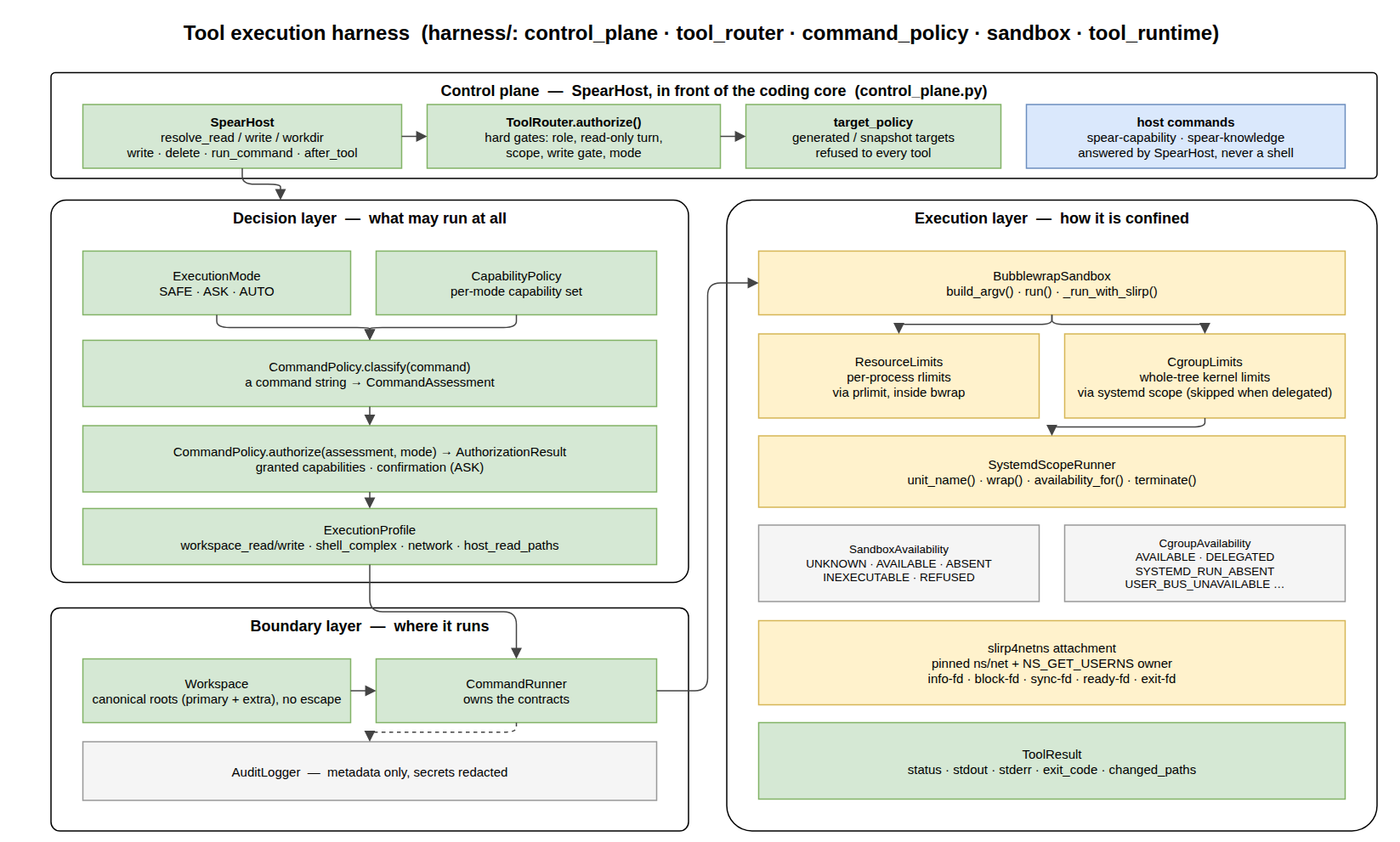
Fig. 5.1 The three layers of the substrate: what may run, where it runs, how it is confined.
5.1.3. Three layers
The substrate is organised as three layers with a one-way dependency: the decision layer never knows how confinement works, and the execution layer never knows why a command was allowed.
5.1.3.1. Decision layer — what may run at all
Type |
Role |
|---|---|
|
|
|
Immutable per-mode capability set. |
|
Classifies a command into a |
|
The outcome: the granted capabilities, or a terminal |
|
The pure execution contract derived from granted capabilities:
|
5.1.3.2. Boundary layer — where it runs
WorkspaceA canonical set of roots that every filesystem tool path must resolve inside.
resolve()rejects traversal, host absolute paths into the launch directory (unless explicitly allowed) and — importantly — symlink escapes, by resolving the whole path including the parent of a not-yet-existing file before checking containment.CommandRunnerOwns the resource contracts (
resource_limits,cgroup_limits) and the sandbox instance. This is the ownership boundary:rag_chatknows nothing aboutMemoryMax,TasksMax,CPUQuota,systemd-runor unit names.AuditLoggerAppend-only, metadata only.
KEY=valueassignments that look like secrets are redacted, and leading environment assignments are stripped before the executable summary is derived.
5.1.3.3. Execution layer — how it is confined
BubblewrapSandboxbuild_argv()composes the structured bwrap argv;run()executes the closed-network path;_run_with_slirp()executes the network path.ResourceLimits/CgroupLimitsTwo orthogonal resource contracts. See Resource control for why there are two and why neither replaces the other.
SystemdScopeRunnerKnows systemd and nothing else. Given an argv and a
CgroupLimitsit produces a wrapped argv; it has no idea what a capability is.ToolResultThe single result type:
status,stdout,stderr,exit_code,changed_paths.statusis one ofok,denied,cancelled,invalid_path,not_found,timeout,failed.
5.1.4. Life of a tool call
ToolExposurePolicysupplies the role’s model-visible registry view.The model proposes a tool call and
ToolRoutervalidates its schema.The router’s hard gates run: the request scope and the target policy (sibling targets, generated and snapshot targets, what a shell command writes, searches outside the project), then the execution modes the tool’s spec declares (
execution_modes).The router invokes the registered handler and observer hooks.
CommandPolicy.classify()classifies the command.The classification is intersected with the capabilities the current mode grants. Anything not granted ends here.
In
ASKmode a confirmation is requested for mutating or network work.CommandRunner.ensure_sandbox()preflights Bubblewrap — once, cached — and for network work also preflights the full slirp path.BubblewrapSandbox.run()checks, before spawning anything: the bwrap binary,prlimitif resource limits are active, the cgroup mechanism if cgroup limits are active, and for network work the slirp helper plus its pinned-namespace support.The command runs, wrapped as described in Sandbox.
The substrate returns a
ToolResult; the router normalizes it as aToolResultEnvelope.Large safe output is kept in
ResultStorewhile only a bounded preview is rendered into model context.Grounded mutations update
WorkingStateand mutating attempts are recorded byAuditLogger.
Every one of the step-9 checks returns a failed ToolResult rather than
proceeding in a degraded mode. There is no code path from “mechanism
unavailable” to “run it anyway”.
A refusal attaches to the file, not to the tool. Generated output (a
generated/ or build/tmp/ path, or a header saying the file is
generated) and snapshot or third-party copies are refused to write_file
and patch, to delete_file – a deleted file could be written afresh –
and to every write a terminal command makes: a redirection, tee, cp,
install, truncate, ln, and any path an inline program mentions.
The decision is taken on the path as written and on the file it reaches, so a
link or a .. does not change it.
A refusal is deterministic, so asking again cannot change it. When a turn
asks for the same refused operation five times – the same tool, target and
refusal once spacing, quoting, a leading ./ and trailing slashes are set
aside – it is stopped with an answer that names the refusal, and the stop is audited
(repeated_refusal_stopped). SPEAR_REFUSAL_REPEATS sets the limit. One
model response is bounded too: SPEAR_RESPONSE_MAX_TOKENS (16384) caps what
a single response may generate, and a response cut there is reported as
truncated.
The core’s terminal is bounded the same way: a call runs for 180 s unless
it asks for another timeout, and one above 600 s is refused; its output is
cut to 50 000 characters, keeping the head and the tail (agent/tools.py).
The timeout replaces the sandbox’s own default (45 s) for that call only.
5.1.5. Once the sandbox is known to be down
The checks above decide one command at a time. One conclusion outlives the
command that reached it: when a command’s output reports the sandbox missing,
_registered_command (the normative runtime’s command handler) records it on
the turn’s cache, and every later file write or deletion in that turn is
refused explicitly instead of performed — the coding core’s write and delete
ports read the same mark.
The reason is not sandbox purity but verifiability. Without the sandbox
nothing the model writes can be read back, compiled or run, so an edit made
from retrieved context alone is a change nobody can check — and the answer the
user needs is that the sandbox is down, not a plausible patch. DENIED and
not FAILED: the tool did not break, it declined.
The guard predates the router and was carried across it deliberately. Keeping
“our side” of that merge would have dropped it silently, since the monolithic
execute_tool it lived in no longer exists.
5.1.6. Preflight caching
Preflight runs a real, minimal sandbox rather than probing version strings —
it executes a small /bin/sh that asserts $PWD, workspace writability,
$HOME and $TMPDIR. Probing what the kernel actually permits is the
only honest test; a version number does not tell you whether unprivileged user
namespaces are enabled.
Results are cached on the sandbox instance, and terminal failures
(ABSENT, INEXECUTABLE, REFUSED) are remembered so a broken
environment is not re-probed on every call. The network preflight is cached
per (sandbox, workspace) pair and invalidated when either changes.
5.1.7. Containment poisoning
The network path has one failure mode that must never be retried blindly: the harness asked the sandbox child to die, and could not confirm that it did.
If _wait_pidfd_exit() cannot observe the child’s termination, the sandbox
sets network_containment_failed and every subsequent network request is
refused for the lifetime of that sandbox object. A namespace whose death is
unverified may still hold a network namespace that a helper is attached to;
continuing would mean starting a second helper against unknown state.
5.1.8. Why the pidfd
Every place the harness signals or observes the sandbox child, it does so through a pidfd, never a numeric PID:
signal.pidfd_send_signal(pidfd, signal.SIGKILL) # not os.kill(pid, ...)
A numeric PID can be reused between the moment it is read and the moment it is
signalled. On a machine that spawns processes as fast as a build does, that is
not a theoretical concern. _stop_namespace_child() retries once through
the same pidfd and has deliberately no os.kill fallback.
The pidfd and the namespace handles introduced in Network backend have distinct roles that are worth keeping straight:
Handle |
Identity it pins |
|---|---|
pidfd |
the process — liveness and safe signalling |
|
the namespaces — stable targets for the network helper |
Neither substitutes for the other, and the code does not conflate them.